

The GST 2.0 rate reset implemented on 22nd September 2025 marks one of the biggest tax reforms since GST was first introduced in 2017. With the removal of the 12% and 28% slabs and a major reclassification of FMCG, medical supplies, and automobile categories, wholesalers and retailers are witnessing a direct shake-up in pricing, compliance, margins, and trade operations.
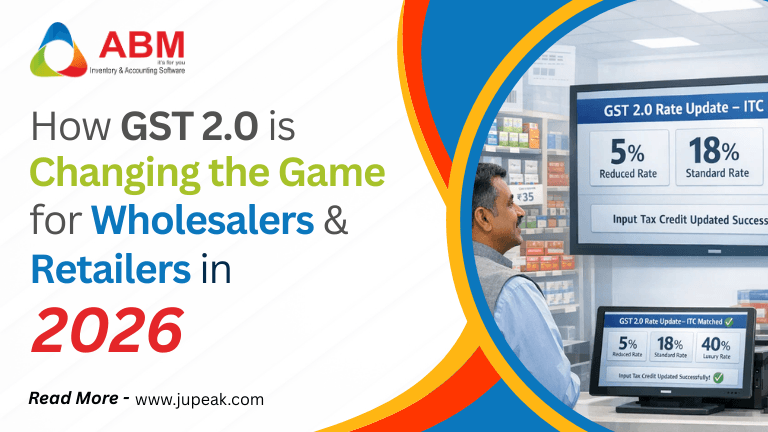
Here’s a clear and simplified breakdown of how GST 2.0 is impacting wholesalers and retailers across India.
GST 2.0: What Has Changed?
The 56th GST Council meeting triggered a sweeping rate restructuring:
- Many FMCG Goods now fall under the 5% or NIL Tax bracket.
- Small Cars are eligible for a reduced GST rate from 28% to 18%.
- Big Cars now attract an effective 40% GST, down from 50%.
- Key Pharma categories—including medicaments, ayurvedic medicines, and medical dressings—are reduced from 12% to 5%.
- GST on Pan Masala, Gutkha, and similar products is now based on Retail Sale Price (RSP).
This restructuring gives wholesalers and retailers immediate pricing leverage while also creating long-term stability in pricing ladders and trade terms.
Impact of GST 2.0 on Wholesalers
Wholesalers function on thin margins and high volumes, making tax changes extremely sensitive to profitability.
With GST 2.0:
- Input Tax Credit (ITC) continuity ensures tax-neutral B2B transactions—provided invoices match, and returns are filed accurately.
- Real-time compliance becomes non-negotiable.
- Rate/HSN mapping across large SKU inventories must be error-free.
- Invoice-level traceability pushes wholesalers into a more formal, transparent trade environment, reducing scope for unreported sales.
- Working capital is now tightly linked to ITC and supplier compliance. Any mismatch can block ITC, creating cash flow pressure.
- Rate resets require immediate action: re-sticker inventory, rework margins, update shelf prices, and coordinate trade schemes.
Over the long term, wholesalers can consolidate networks, renegotiate logistics terms, and expand into new markets due to the trade formalisation push.
Impact of GST on Retailers
Retailers gain from GST 2.0 primarily through better margins and more consistent pricing across states:
- ITC on purchases reduces embedded costs, helping stabilise gross margins—if invoices are compliant.
- With reduced inter-state tax differences, competition shifts from tax-based pricing to customer service, assortment, and availability.
- POS systems and ERPs must be updated with revised SKUs, HSN codes, and GST rates to avoid mismatches during audits.
- Online retailers must additionally manage marketplace TCS reconciliation and return adjustment complexities.
Retailers with fixed-price packs (₹5, ₹10, ₹20 FMCG SKUs) must also ensure grammage adjustments and updated MRPs to pass benefits smoothly to consumers.
A Look Back: GST vs. Demonetisation
The industry’s reaction to demonetisation in 2016 offers a strong contrast. Back then, panic-led destocking caused FMCG sales to drop by over 44% in Q3 FY17, according to Care Ratings. In comparison, GST 2.0 has led to more structured, planned transitions driven by compliance rather than fear.
Final Thoughts
The GST 2.0 Rate reset is a progressive move that simplifies Tax Structures, Enhances Compliance Discipline, and Boosts Long-term Growth for Wholesalers and Retailers. While the transition phase requires Planning, Repricing, ITC Syncing, Documentation, and SKU Remapping, Long-term Benefits are Clear: Predictable pricing, better margins, expanded opportunities, and a more formalised marketplace.
CTA: And this is the right time to sit with your Team and review how GST 2.0 is being handled in your current software billing, ITC, rate mapping, and compliance. And if your existing System is not fully Supporting You, the simple solution is ABM Billing Software, built to help businesses stay GST-ready with Accuracy and Ease.
How GST 2.0 Is Changing the Game for Wholesalers and Retailers in 2025.